

REVIEW · USA
Freedom Trail Walking Tour 250
Boston’s Freedom Trail is easy to follow on your own, but a good guide gives the brick path a human voice. This tour brings colonial Boston to life through costumed storytelling, stopping at places tied to Benjamin Franklin, Paul Revere, Samuel Adams, and the American Revolution. The route covers about 1.2 miles in 1 hour 45 minutes.
I like the tour’s manageable length and its focus on key sites rather than a long march across the city. I also like the guides who make the past feel personal, especially Ben, Elizabeth, Elaina, Catherine, and Mark, all praised for strong storytelling and an easy pace. The main caution is that quality depends heavily on your guide, and a large group or a guide who leans too hard on jokes can make the history feel thin.
Key points at a glance
- About 1.2 miles in 1 hour 45 minutes: A useful first look at old Boston without taking up half your day.
- Costumed, in-character guides: Expect history told through performance, humor, and stories about ordinary colonial life.
- Granary Burying Ground gets 20 minutes: This is the longest stop and a major part of the tour.
- Nine named stops plus nearby historic sites: The route includes Park Street Church, King’s Chapel, the Boston Massacre site, and Faneuil Hall.
- $26 per person: Fair value if you want context and storytelling, less so if you prefer a quick self-guided walk.
- A maximum of 50 people: The group may feel crowded around narrow sidewalks and busy historic sites.
Why a guide helps on Boston’s brick trail
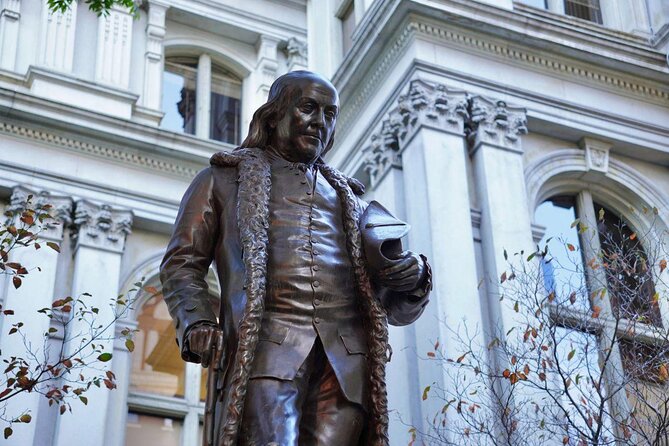
The Freedom Trail is marked through central Boston, and you can walk much of it without paying anything. The challenge is knowing what to look at and why it mattered. A guide can connect a church, a graveyard, a school, and a meetinghouse into one clear story about colonial Boston and the fight for independence.
That connection is the real reason to book. You are not simply checking off old buildings. You are hearing how religion, trade, education, protest, and politics met on a few compact city blocks.
The tour is designed as an introduction, not a full study of Boston history. It does not provide long visits inside every building, and the schedule leaves little room to linger. I would use it early in a Boston stay, then return to the places that catch your interest.
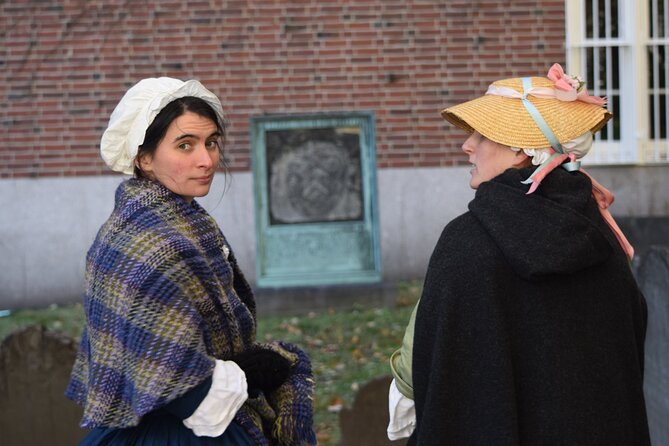
The format is theatrical. Guides remain in character and may dress as people from the period or as a colonial-era resident. The strongest guides use that approach to make the past easier to remember. Ben is praised for holding attention in cold weather, while Elizabeth is described as welcoming and clear. Elaina is especially good with families and younger children, based on the strong response to her lively style.
The tradeoff is simple: some guides use humor more successfully than others. If you want a formal lecture with careful academic detail, this may not be your ideal tour. If you want a lively introduction that keeps children and teenagers listening, the format can work very well.
More Walking Tours in the USA:
- Boston Freedom Trail Walking Tour with Costumed Guide
★ 4.5 · 2,531 reviews - Entire Freedom Trail Walking Tour: Includes Bunker Hill and USS Constitution
★ 5.0 · 732 reviews - From Miami: Everglades Airboat Ride and Nature Walk
★ 4.8 · 459 reviews
Starting near the Massachusetts State House and Park Street Church
The tour begins around the current Massachusetts State House area, then moves to Park Street Church. The church is tied to the first performance of My Country ’Tis of Thee, a detail that gives the opening stop a cultural link beyond architecture.
You will spend about five minutes here, so expect a brief explanation rather than an indoor visit. The stop works as an opening note, placing you in the center of Boston’s historic core before the tour turns to people, graves, and revolutionary conflict.
The first part of the route also gives you a feel for the walking conditions. The distance is not great, but city sidewalks, crowds, and frequent stops can slow the pace. Wear shoes you can walk in comfortably. The tour operates in all weather conditions, so rain, cold, or heat can change the experience more than the mileage suggests.
Granary Burying Ground and the people behind the revolution
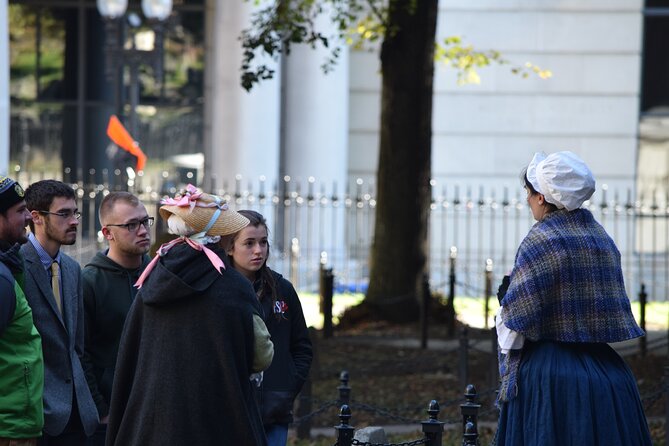
Granary Burying Ground receives about 20 minutes, the longest scheduled stop. That tells you where much of the tour’s storytelling takes place.
This cemetery is important because it contains the graves of major figures from the American Revolution and early United States. The guide uses the site to discuss the Founding Fathers and the people connected to Boston’s political rise.
I like this stop when the guide gives you more than names and dates. The cemetery allows room for stories about ambition, protest, loyalty, and the difficult choices made during the colonial period. It is also a useful place to see how close together Boston’s historic institutions are.
Still, 20 minutes in one cemetery may feel long if your interest is mainly in buildings and street scenes. One tour account found there was too much talking and not enough walking, with too little time for questions. The experience depends on how well the guide varies the pace and handles the group.
Because this is a popular historic site, sound matters. A strong guide such as Elizabeth or Ben can project well and keep the group together. In a large crowd, you may need to move closer to hear every detail.
King’s Chapel and Boston’s early religious life
The next stop is King’s Chapel, described as America’s first Anglican church. You get about five minutes here, enough for a short explanation of its role in Boston’s colonial religious life.
This stop helps broaden the story. The Freedom Trail is not only about battles and famous patriots. It also reflects the religious divisions that shaped the colonies. Anglican, Puritan, and other Christian traditions all had a place in Boston’s early civic life, and churches were closely tied to politics and social rank.
The tour also notes Boston’s oldest English burial ground near this portion of the route. The schedule does not promise an extended visit or admission inside the chapel, so think of this as a quick orientation stop. If King’s Chapel interests you, save time after the walk to explore it on your own, if open.
A few more hikes around the USA worth a look
- Lower Antelope Canyon Hiking Tour
★ 5.0 · 6,216 reviews - Multnomah Falls and Columbia River Gorge Half-Day Hiking Tour
★ 5.0 · 2,108 reviews - San Francisco: Yosemite National Park & Giant Sequoias Hike
★ 4.5 · 1,777 reviews - Valley of Fire Guided Hike from Las Vegas
★ 5.0 · 1,611 reviews
Boston Latin School and Benjamin Franklin
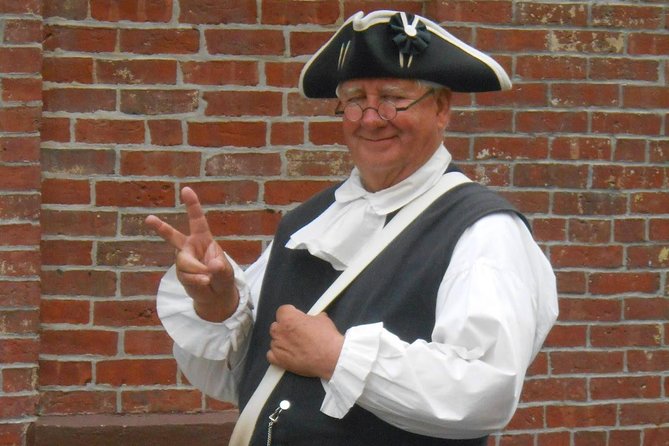
At Boston Latin School, you hear about America’s first public school. The stop lasts about five minutes, but it adds an important subject to the tour: education.
The school is also linked to Benjamin Franklin, its most famous alumnus. Nearby, a statue of Franklin provides the setting for a short account of his life and his place among the Founding Fathers.
I find this pairing useful because it shows Boston through more than revolutionary slogans. Franklin’s connection to the school gives the guide a way to discuss learning, social mobility, printing, and public life. It also offers families a clear point of interest for children who may recognize Franklin more easily than lesser-known colonial figures.
The guide will not have time for a full biography. You are getting a compact story at a public statue, not a museum visit. Still, the stop works well as part of the larger thread linking Boston’s schools, churches, businesses, and political meetings.
Old Corner Bookstore and the power of print

The Old Corner Bookstore is identified as America’s oldest commercial building. It is also associated with the publication of The Midnight Ride of Paul Revere.
This five-minute stop explains why print mattered in colonial and early American life. Books, pamphlets, and newspapers helped spread political ideas, shape public opinion, and turn local disputes into causes that reached far beyond Boston.
The building itself is a reminder that the revolutionary story did not happen only on battlefields. It was also built through words. A guide with a good sense of timing can make this short stop feel connected to the larger story rather than just another old facade.
You should not expect a long interior visit here. Like several stops on the route, the value comes from the explanation and the location.
Old South Meeting House and the Boston Tea Party
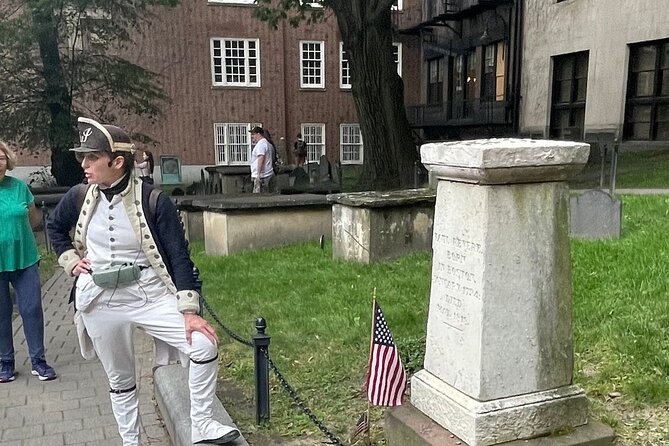
The tour then reaches Old South Meeting House, where you hear about the Boston Tea Party. The stop lasts about 10 minutes, and admission is not included in the $26 tour price.
That last detail matters. The tour can explain the site from outside, but entering the building may require a separate ticket. If you want to see the interior, check the site’s current admission arrangements and allow extra time after the walk.
Old South Meeting House is one of the best places on this route for understanding how protest grew into organized resistance. The Boston Tea Party was not a random act of mischief. It followed heated debate about taxation, representation, imperial authority, and the right of colonists to challenge decisions made across the Atlantic.
A guide can make this stop especially useful by explaining the crowd and the public meeting tradition. This is also a point where a strong storyteller can keep the group engaged without reducing the event to a simple heroic tale.
The Boston Massacre site and a change in public opinion
The Boston Massacre site receives about 10 minutes. Here, the guide explains the incident that became a rallying cry during the American Revolutionary War.
This is one of the tour’s most valuable stops because it shows how language can shape politics. The word massacre carried enormous force, even though the event itself involved a tense confrontation between civilians and soldiers. The guide’s job is to explain both the event and the way it was used in colonial protest.
The stop sits in a busy part of the city, so you may be standing near other groups and ordinary street traffic. Clear delivery helps. Catherine is praised for answering questions well, and that ability matters at a site where people often want clarification about the sequence of events.
The tour also includes a brief connection to Samuel Adams. This helps bring the story back to Boston’s political organizers and the local figures who helped turn anger into action.
Faneuil Hall, Samuel Adams, and the end of the route
Faneuil Hall Marketplace is one of Boston’s best-known historic attractions, and it appears near the end of the route. You get about five minutes here, with the guide tying the site to Boston’s public and political life.
The stop can feel short because Faneuil Hall and the surrounding marketplace offer plenty to see. I would treat the tour’s stop as an introduction, then return later if you want more time in the building or the market area.
The route description also points toward the Paul Revere House, built in 1680 and described as Boston’s oldest surviving residential building. The schedule does not list a separate timed stop or included admission for an interior visit, so do not assume that the tour includes entry. It is best to ask the guide where the walk ends and plan a separate visit if Paul Revere’s home is high on your list.
This final section brings together the tour’s themes: protest, public speech, trade, and the people who pushed Boston toward revolution. It also places you in a useful area for continuing on foot to other historic attractions.
What $26 buys you
At $26 per person, the tour is reasonably priced for a professional guide and nearly two hours of structured storytelling. You are paying for interpretation, not access to a series of paid museums. Most outdoor stops are free, while Old South Meeting House admission is not included.
I would call it good value for a first visit, especially if you want help sorting out a crowded and complicated historical center. The price is less attractive if you already know Boston well or prefer to read plaques at your own pace.
The advertised group maximum is 50 people. That is not a small group, and narrow sidewalks or crowded cemeteries may make it hard to stay close to the guide. On the plus side, the pace is described as comfortable, and the total walking distance is moderate.
The tour is offered in English and uses a mobile ticket. It is near public transportation, and service animals are allowed. Most people can take part, but you should be ready to walk and stand outdoors for nearly two hours.
Choosing the right guide and style
The guide can make or break this experience. Names associated with particularly strong tours include Ben, Elizabeth, Elaina, Catherine, Mark, Mrs. Palmer, and Jeremiah Poope. Their styles vary, but the best guides share a few traits: they speak clearly, connect the stops, answer questions, and keep the pace moving.
Some guides take on a full character, such as a colonial woman or a figure connected with Boston’s past. That can be great for children and teens. One particularly theatrical approach kept an entire family engaged, including a four-year-old.
The risk is overacting. A guide who relies on weak jokes or casual nicknames for major historical figures may frustrate you if accuracy and respect matter most. I would choose this tour for lively storytelling, while keeping in mind that not every guide will deliver the same balance of humor and detail.
Practical advice before you book
Book ahead if your dates are fixed. This experience is booked an average of 13 days in advance, which suggests that popular start times can fill before your trip.
Choose a time when you can manage outdoor walking in Boston’s weather. The tour runs in all weather conditions, so bring suitable clothing and shoes. A wet or cold day may make the cemetery stop and street talks feel longer.
Arrive ready to listen from the start. The tour is only 1 hour 45 minutes, and the guide has many sites to cover. If you want photographs, take quick ones and stay near the group.
Free cancellation is available up to 24 hours before the start time for a full refund. Changes made less than 24 hours ahead are not accepted, and a cancellation caused by poor weather offers a different date or a full refund.
Should you book the Freedom Trail Walking Tour?
I would book this tour if you are visiting Boston for the first time, want a clear introduction to the Freedom Trail, or are traveling with children who need stories rather than signs and plaques. The short distance, central location, and costumed format make it an easy first activity.
I would skip it if you want a small private walk, long interior visits, or a strictly academic presentation. The group can be sizable, and the guide’s personality has a large effect on the day.
At $26, the tour earns its price when the guide links the stops into one story. Look for a guide who is clear, energetic, and respectful of the history. If you get that combination, Boston’s old streets become far more than a line of red bricks.
FAQ
How long is the Freedom Trail walking tour?
The tour lasts approximately 1 hour and 45 minutes.
How far do you walk?
The route covers approximately 1.2 miles, or two kilometers.
How much does the tour cost?
The price is $26 per person.
What language is the tour offered in?
The tour is offered in English.
Is admission to Old South Meeting House included?
No. Admission to Old South Meeting House is not included in the tour price.
Does the tour operate in bad weather?
The tour operates in all weather conditions, and you are advised to dress appropriately. If the experience is canceled because of poor weather, you are offered a different date or a full refund.
How large can the group be?
The stated maximum is 50 travelers.
Can I cancel for a full refund?
Yes. You can cancel up to 24 hours before the experience start time for a full refund. Cancellations or changes made less than 24 hours before the start time are not accepted for a refund.
Just added around the USA
- Anchorage: Full-Day Matanuska Glacier Hike and Tour★ 4.7 · 48 reviews
- Oahu: Manoa Falls Hike and east side beach day★ 4.9 · 10 reviews
- From Springdale: Greater Zion Scenic Hiking Tour★ 4.9 · 21 reviews
- From Springdale: The Zion Narrows Hike with Lunch★ 4.8 · 85 reviews
- From Seward: Harding Icefield Trail Hiking Tour★ 5.0 · 11 reviews
- From Sedona: Archeology and Nature Hike★ 4.9 · 8 reviews
- From Seward: 6-hour Wilderness Hiking Tour★ 4.5 · 5 reviews
- From Rapid City: Private Devils Tower Tour and Hike★ 5.0 · 6 reviews
USA Hiking Tours, compared.

Small Group: Valley of Fire Half Day Tour from Las Vegas
Read our review →
Multnomah Falls and Columbia River Gorge Half-Day Hiking Tour
Read our review →
San Francisco: Yosemite National Park & Giant Sequoias Hike
Read our review →

Small Group Waterfall and Rainforest Hiking Adventure on Maui
Read our review →

Kauai Adventure: Kayak & Hike to Secret Falls with Expert Guide
Read our review →Browse the lists this tour appears in