
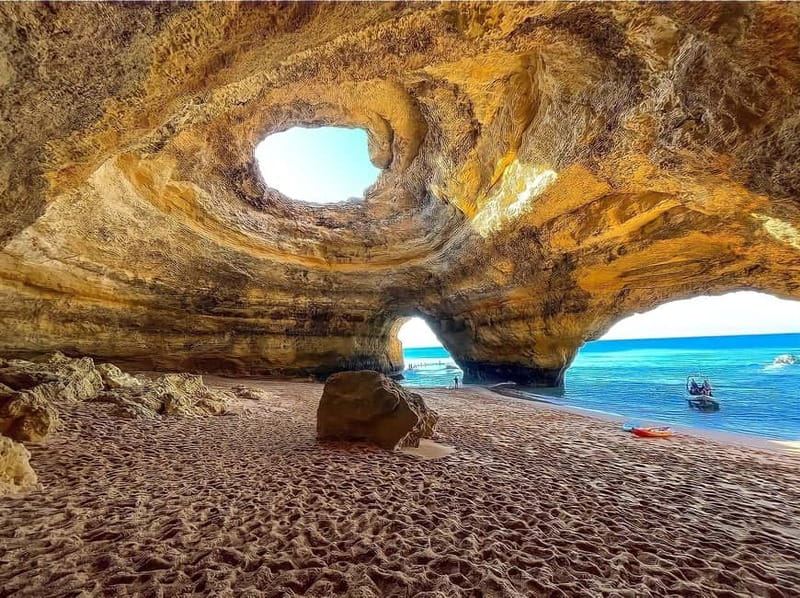
REVIEW · PORTUGAL
Guided hiking tour on the Seven Hanging Valleys Trail
The Seven Hanging Valleys Trail gives you the Algarve coast in one well-packed morning: golden beaches, cliffs, caves, arches, lighthouse views, and a path that rises and drops across six kilometers. The walk begins at Praia da Marinha and finishes at Praia de Vale Centeanes, with transport returning you to Marinha.
I like the small group limit of 12 people, which gives guides such as Tamara, Alex, Alexandre, and Walter room to help with tricky footing and explain the coast. I also like the useful extras: water, fruit or a snack, guide-taken photos, and a stop at a wild beach. The main catch is that this is a real coastal hike, not a flat stroll. Expect dirt, rock, ravines, climbs, sun, and no circular walking route.
Key points to know before you book
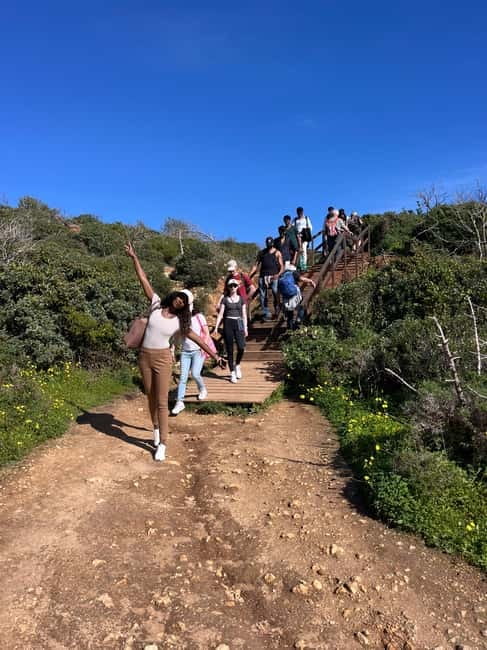
- Marinha’s heart-shaped arches: The tour begins among some of the Algarve’s most striking limestone formations, with time for photos and a guide-led look at the coast.
- Benagil from the cliff path: You see the famous cave area from land, but this is not a boat, kayak, or swimming tour.
- A 6 km one-way hike: The route runs from Praia da Marinha to Praia de Vale Centeanes, then return transport takes you back.
- Small groups and patient guides: The group is limited to 12, and guides have helped walkers who needed extra care on uneven ground.
- Good value at $42: Water, a snack, photos, insurance, a wild beach stop, and return transport are included.
- A proper outdoor outing: Good shoes, sunscreen, sunglasses, and breathable clothing matter more here than fancy holiday clothes.
Why the Seven Hanging Valleys Trail is worth your morning
The Algarve is famous for beaches, but this walk shows you the coast between the beaches. The route follows a high strip of limestone between Praia da Marinha and Vale Centeanes, crossing a series of ravines that end above the sea.
These are the hanging valleys. Long ago, each was linked to a river mouth. The coastline then pulled back faster than the water could cut down into the rock, leaving valleys suspended above the sea. You do not need a geology degree to enjoy the result. The cliffs are full of holes, arches, caves, shelves, and pale rock shaped by fresh and salt water.
The route is about six kilometers and takes around three hours. That time includes stops, explanations, photos, and short breaks, so you are not walking hard for three straight hours. Still, the path is uneven and sometimes rocky. The repeated climbs and descents are the part to take seriously.
The group limit of 12 is a real advantage. A guide can keep an eye on the slower walkers, pause at good viewpoints, and explain small details that are easy to miss when you walk alone. Tamara was especially praised for helping people who struggled with balance, while Alex and Alexandre were singled out for friendly, engaging guiding.
More Guided Day Hikes in Portugal
- PR1 Sunrise Pico do Arieiro Self-Guided Hiking Transfer
★ 5.0 · 299 reviews - From Funchal: Ponta de São Lourenço/Caniçal Full-Day Hike
★ 4.6 · 262 reviews - Half-day Hike & Picnic with Dog Love in Porto’s Mountains
★ 5.0 · 136 reviews
Starting at Praia da Marinha
Meet at the Praia da Marinha parking lot, in front of the food trucks. Arrive 10 minutes early and look for a guide wearing a T-shirt with the XploreBenagil logo.
Praia da Marinha is an excellent starting point because the scenery begins before the walk does. The beach is known for its golden sand, clear coastal views, and tall limestone formations. It has also been named among the world’s top beaches by the Michelin guide.
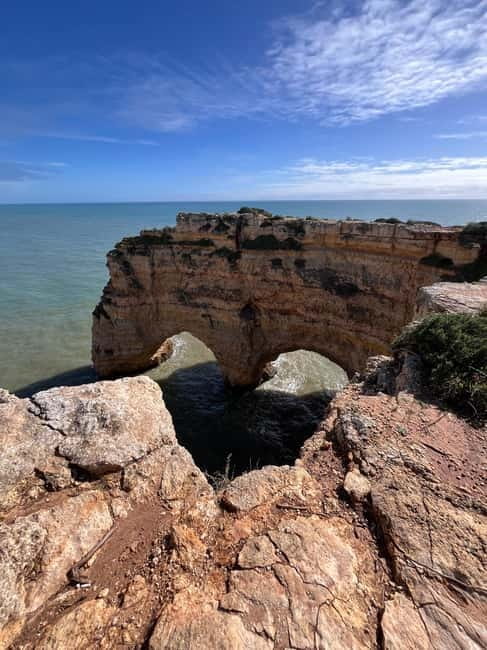
The first part of the experience is not simply a march toward the next stop. Your guide points out the formations around the beach and helps you understand how the coast was shaped. This is where the tour’s photo service is useful, especially for pictures of the famous heart-shaped Marinha arches.
Bring your phone or camera, but do not plan the whole morning around posing. The value of this start is seeing the arches from several angles as the trail moves above the shore.
Marinha’s arches and the karst coast
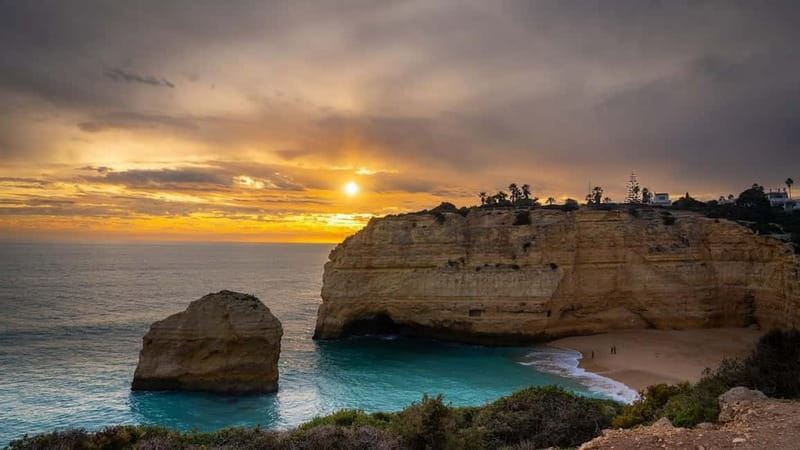
The rock around Praia da Marinha is a fine example of a karst coast, a type of terrain shaped by water working through limestone. Here, that process has produced natural arches, caves, sinkholes, and shallow rock shelves.
The guide-led explanation adds something useful. On your own, you might stop at an arch and take a picture. With a guide, you get the larger story of why the cliff has holes and breaks in some places, while other sections remain solid.
The terrain also shifts underfoot. Some stretches are packed dirt, while others are rougher and stony. Comfortable sports shoes may be enough for confident walkers, but hiking shoes are the safer choice if you dislike slipping or want more support.
The views are the star, but look down as well as out. The route is not difficult in a technical climbing sense, yet the rock and ravines demand attention. This is one reason the tour is not suitable for people with serious back problems or kidney problems.
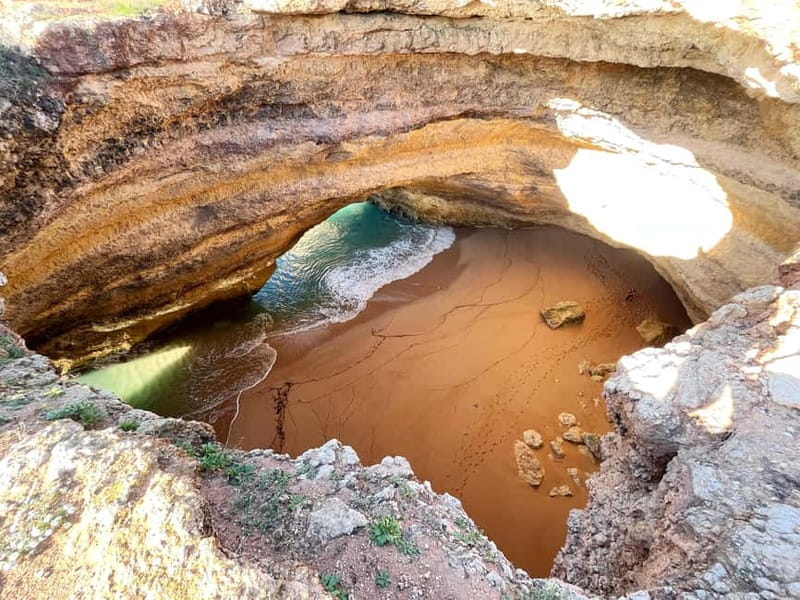
Benagil Cave from above
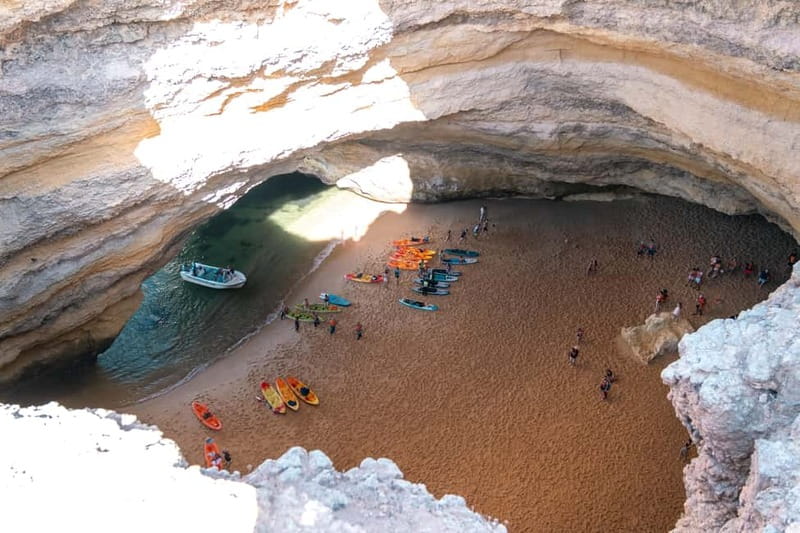
Benagil is one of the Algarve’s best-known coastal sights. The beach sits beside the mouth of a narrow gully carved by a torrential river, and the cliffs contain the large sea cave that appears in so many Algarve photographs.
This tour visits the Benagil cave area from the walking route. You get a photo stop and views of the cave, but the experience does not include a boat ride, kayak trip, or entry into the cave by water. That distinction matters because many people see the word Benagil and expect an aquatic excursion.
The route gives you a slower view of the setting. You can see how the beach, gully, cliff, and sea fit together. The guide can also explain the older fishing role of Benagil Beach. The area once supported a fishing community focused on small-scale fishing, while boats today are mainly used to reach the caves.
Do not expect a long beach stop here. The tour has several sights to cover in three hours, so Benagil works mainly as a viewpoint and photo stop.
Same trailhead, a different sort of day:
- Funchal: Pico do Arieiro Sunrise Hiking Transfer
★ 4.8 · 4,021 reviews - Madeira: Pico Arieiro to Pico Ruivo Hike
★ 4.6 · 2,224 reviews - Funchal: Pico do Arieiro & Pico Ruivo Hiking Transfer
★ 4.9 · 1,845 reviews - Rabaçal: 25 Fontes & Risco Levada Hiking Transfer
★ 4.8 · 1,670 reviews
Carvalho Beach and the tunnel in the rock
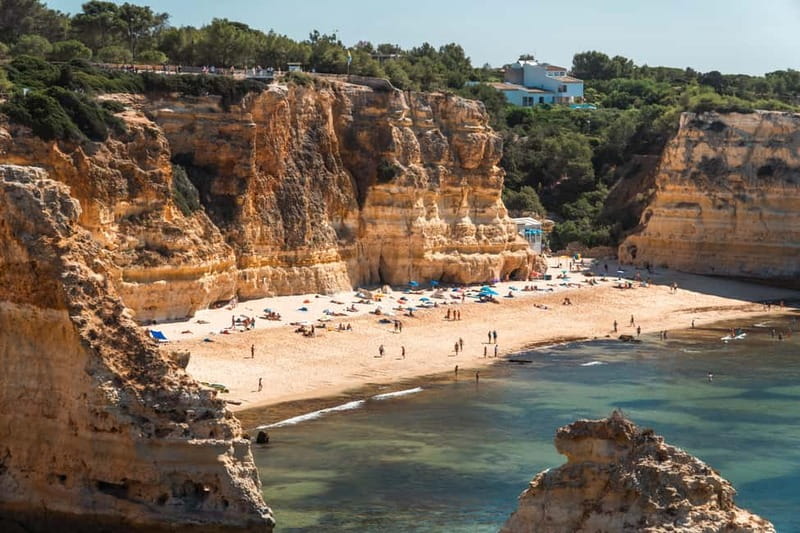
Praia do Carvalho is one of the more unusual stops because the sand is reached through a tunnel cut into soft Miocene limestone. The rock contains many sea shells fixed into its matrix, giving you a close look at the material that forms much of this coast.
The beach itself adds variety after the high cliff sections. You get a more intimate cove feel, though the access and uneven surfaces mean you should keep your shoes on until the guide indicates otherwise.
This is also a good area for noticing the plant life. The Mediterranean scrub includes dwarf palm, the only native European palm species mentioned along this route. If you enjoy small natural details, pause for the guide’s explanation rather than treating the beach as just another photo backdrop.
One review specifically praised the guide’s explanations of the local plants and animals. That is useful here because the vegetation can look like ordinary scrub at first glance. A closer look reveals a coast adapted to heat, wind, thin soil, and exposed rock.
The bare cliffs and the story of Leixão do Ladrão
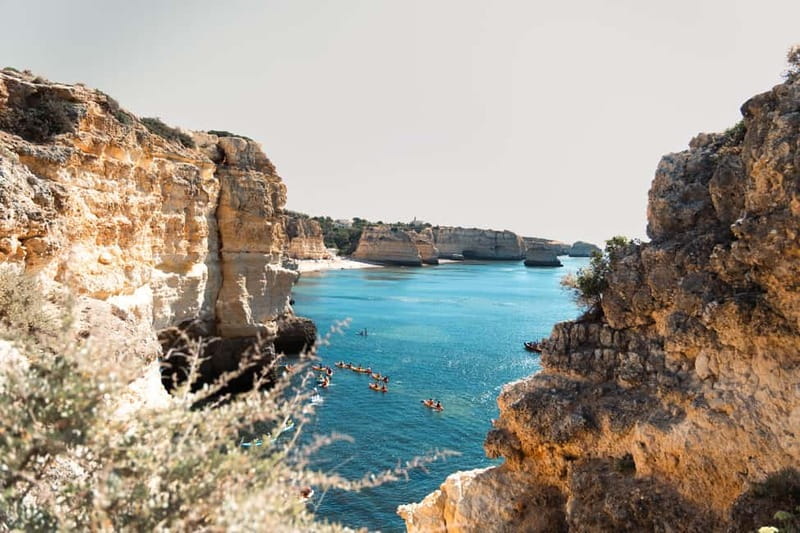
As the trail continues, the thick green scrub gives way to paler, more open rock. The change can feel almost lunar. The limestone is exposed, sunlit, and sharply marked by erosion.
Around the large rock known as Leixão do Ladrão, your guide may share the local legend of a Moorish princess mourning her lover. In the story, her tears helped create the lace-like patterns in the limestone.
You do not need to treat the tale as geology. That is part of the charm. The natural shapes invite stories, and the story gives you another way to remember the rock. It also breaks up the technical explanations about rivers, erosion, and limestone.
This stretch can feel more exposed than the sections with shrubs. Wear sunscreen, bring sunglasses, and choose breathable clothes. A light jacket is also sensible because coastal conditions can change, and the tour’s preparation list includes one.
Alfanzina Lighthouse and coastal wildlife
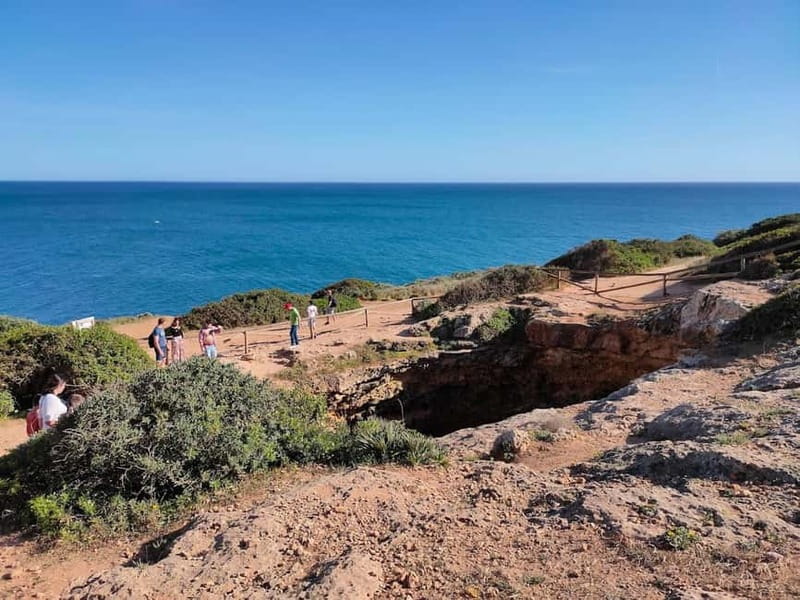
Near Alfanzina Lighthouse, Aleppo pine grows among the dry, stony ground. These trees are among the few able to colonize such harsh conditions, and they create small pockets of shelter for birds and other animals.
The pine stands can support tits, blackbirds, and Galician owls. The surrounding area also provides habitat for rabbits, pythons, and foxes. This does not mean you should expect a wildlife show. The point is that the guide can help you see the coast as living habitat, not just a line of cliffs and beaches.
The lighthouse section offers a change of mood. After the bare rock and open sea views, the trees give the trail a little shade and texture. It is a good time to drink some of the supplied water and take a short break.
The itinerary allows around three hours for the full guided route, not three hours at every stop. The guide needs to keep the group moving, so this is best for people who prefer several varied sights over a long, lazy beach stay.
Finishing at Vale de Centeanes
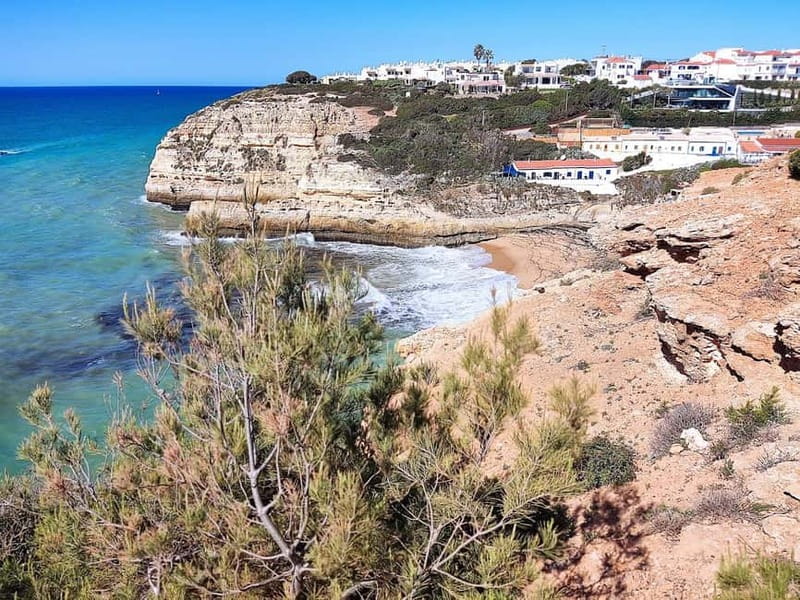
The walking route ends at Praia de Vale Centeanes. This is the far end of the coastal section, after the arches, ravines, Benagil area, Carvalho Beach, and Alfanzina Lighthouse.
The route is not circular. You walk from Marinha toward Centeanes, then use the included return transfer to get back to the Marinha parking area. That arrangement saves you from retracing six kilometers and makes the experience practical for a short holiday schedule.
Because you finish at a different beach, the walk feels like a point-to-point coastal journey rather than a loop around one attraction. You see the scenery change as you go, and the return ride lets you rest after the final climb and descent.
The return transfer comes back to the place where you met the guide, in front of the food trucks at Marinha. Keep that meeting point in mind if you are arranging the outing around a rental car or another activity.
What $42 includes
At $42 per person, the tour is priced as a guided outdoor activity rather than a simple trail walk. You are paying for a guide, a small group, return transport, water, fruit or a snack, insurance, a wild beach stop, and photos taken during the activity.
The return transport is particularly useful. A self-guided walk would require planning how to move between the start and finish, while this tour handles that part for you. The included photos also mean you can enjoy the walk without asking your companion to take every picture.
The price is strongest for visitors who want context and support. If you already know the route, have transport arranged, and prefer walking alone, the guided format may feel less necessary. But if you want the geology, plants, stories, viewpoints, and logistics handled in one morning, $42 is fair.
Water and a snack are welcome extras, though you should not treat them as a full meal. Eat beforehand if you normally need a substantial breakfast before a three-hour hike.
Guides, languages, and the group feel
Guiding is offered in Portuguese, English, and Spanish. The guide names associated with the experience include Tamara, Alex, Alexandre, Walter, and Deenish.
The strongest pattern in the feedback is the quality of the guiding. Tamara was praised for her explanations of plants, animals, and geological formations, as well as her patience when walkers had trouble with balance. Alex was described as especially warm and helpful, while Alexandre received praise for his friendly manner.
That matters on this trail. A guide who simply leads the way is useful, but a guide who watches the group and adjusts the pace is more valuable on uneven coastal ground. The small group limit makes that level of attention more realistic.
Your experience will depend partly on which guide leads the outing. The consistent points to look for are clear explanations, help on rough sections, and time at the main viewpoints.
Who should book this hike
I would choose this tour if you want the Algarve’s famous coast but prefer active sightseeing to sitting on one beach. It suits people who enjoy photography, natural history, short hikes, and a guide who can add meaning to what they see.
It is also a good fit if you do not have a second car for a point-to-point route. The transfer removes a practical problem and lets you focus on the walk.
You should think twice if you want a flat path, a swimming day, or an unhurried visit to Benagil Cave from inside the water. This is not a boat tour, and the six-kilometer trail includes climbs, drops, rough ground, and exposed sections.
The stated limits also matter. The activity is not suitable for people with back problems, kidney problems, people over 75, or anyone over 220 pounds, or 100 kilograms. Those rules are best treated seriously rather than as minor fine print.
Wear hiking shoes or sturdy sports shoes, comfortable clothes, sunscreen, sunglasses, and a light jacket. Arrive 10 minutes early at the food trucks in the Marinha parking lot.
Should you book the Seven Hanging Valleys tour?
Book it if you want a compact, guided introduction to the Algarve’s most dramatic coast, with transportation and a small group included. The best parts are the variety of the route, the Marinha arches, the Benagil viewpoints, the limestone details, and guides who appear prepared to help when the trail gets awkward.
Skip it if you are looking for a relaxed beach transfer, a cave-swimming trip, or a level walk. For the right walker, $42 buys more than a route marker. It buys a well-organized morning that connects the beaches, cliffs, plants, stories, and geology into one memorable coastal outing.
FAQ
Where does the Seven Hanging Valleys hike begin?
The hike begins at the Praia da Marinha parking lot, in front of the food trucks.
Where does the walking route finish?
The walking route finishes at Praia de Vale Centeanes.
How do I return to Praia da Marinha?
Return transport is included and takes you back to the same place where you met the guide at Praia da Marinha.
How long is the route?
The route is approximately 6 kilometers and takes about 3 hours, including guided stops and photo breaks.
Is the route circular?
No. It is a point-to-point route from Praia da Marinha to Praia de Vale Centeanes, with return transport afterward.
Is Benagil Cave visited by boat?
No. This activity is a guided hiking tour. Benagil Cave is included as a viewpoint and photo stop, not as a boat, kayak, or swimming visit.
What languages are available?
Guides lead the activity in Portuguese, English, and Spanish.
What should I bring?
Bring comfortable or hiking shoes, comfortable outdoor clothing, sunscreen, sunglasses, breathable clothing, sportswear, and a jacket.
Is food and water included?
Yes. Water and fruit or a snack are included in the price.
Can I cancel the booking?
You can cancel up to 24 hours in advance for a full refund. You can also reserve now and pay later.
Just added around Portugal
- Madeira: Hike Transfer to Ponta de São Lourenço (PR8)★ 4.8 · 26 reviews
- Funchal: Pico Grande Guided Hike with Curral das Freiras★ 5.0 · 6 reviews
- Funchal: PR1.2 Pico Ruivo & Achada Teixeira Hiking Transfer★ 4.9 · 27 reviews
- From Tavira: 7 Valleys Hiking, Benagil Cave and Snorkeling★ 4.8 · 8 reviews
- From Sintra, Mafra, or Ericeira: Hike and Wine Tour★ 5.0 · 4 reviews
- Leave Porto and go hiking in the Paiva Walkways, Arouca★ 4.8 · 30 reviews
- From Ponta Delgada: Hiking Moinho do Félix★ 5.0 · 5 reviews
- From Olhão: 7 Valleys Hiking, Benagil Cave, Snorkeling Tour★ 4.7 · 3 reviews
Portugal Hiking Tours, compared.

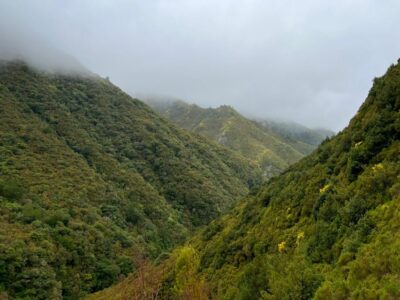
Rabaçal: 25 Fontes & Risco Levada Hiking Transfer
Read our review →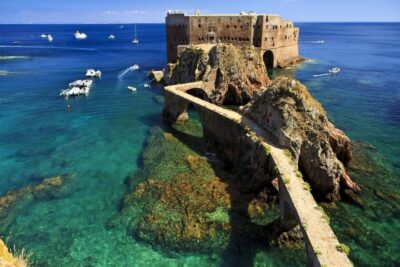
Peniche: Berlengas Island Trip, Hiking and Cave Tour
Read our review →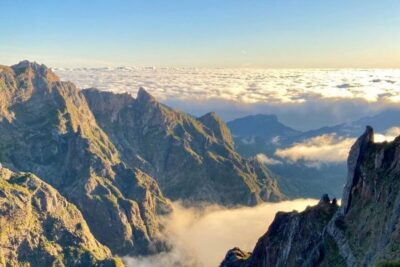
Pico Do Arieiro Pico Ruivo Sunrise or Morning Hike Transfers
Read our review →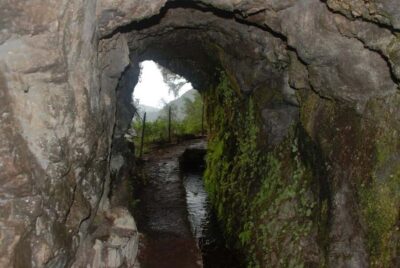
Caldeirão Verde: Levada Caldeirao Verde Hiking Transfer
Read our review →
Browse the lists this tour appears in